3 Morning Habits That Win Government Contracts (And Build Wealth)
Jan 19, 2026The Three Sales Habits You Must Build to Win in Government Contracting
In this video, I break down three habits that I believe are non-negotiable if you want to succeed selling to the U.S. government.
I’m sharing this not as a theorist, but as someone who spent years inside government acquisitions and now works every day with business owners, consultants, and sales leaders trying to break into — or scale — government contracting.
And here’s the uncomfortable truth I start with:
most companies don’t fail in government contracting because of their product, their technology, or their engineering. They fail because they neglect sales.
It doesn’t matter if you’re a founder, a technical expert, or a sales executive. If you don’t build intentional, repeatable sales habits, you will struggle to win contracts — and even if you win one, you’ll struggle to sustain growth.
Government contracting rewards discipline far more than brilliance.
Habit #1: Consistent Lead Generation — Before the Solicitation Drops
The first habit is consistent, proactive lead generation.
Not chasing RFPs at the last minute.
Not reacting when something hits your inbox.
But deliberately identifying opportunities before a formal solicitation is ever released.
This is where most contractors already fall behind.
In the video, I walk through how I personally look for early-stage opportunities using sources like SAM.gov, Sources Sought notices, Requests for Information (RFIs), and non-traditional channels such as the Defense Innovation Unit (DIU) and other OTA-based platforms.
The key point I make is this: if you only look where everyone else is looking, you will compete where everyone else is competing.
Early signals tell you:
-
What agencies are thinking about buying
-
How they’re framing the problem
-
Whether funding is likely
-
What capabilities they’re trying to understand
This gives you time — time to prepare, time to position yourself, and time to influence outcomes instead of reacting to them.
Lead generation in government contracting isn’t about volume. It’s about timing and awareness.
Habit #2: Daily Pipeline Management Using a CRM Built for Government Sales
The second habit is disciplined pipeline management.
I see this mistake constantly: contractors rely on memory, spreadsheets, inboxes, or “we’ll remember it later.” That might work in commercial sales. It does not work in government contracting.
In the video, I explain why I believe you must manage your pipeline daily using a CRM that is actually designed for how government opportunities work.
That means tracking:
-
Where each opportunity is in the acquisition lifecycle
-
Estimated award timelines (which are never exact)
-
Realistic close rates
-
Contract size and impact on revenue
This isn’t busywork — it’s risk management.
Government contracts get delayed.
Budgets get frozen.
Awards get canceled.
Shutdowns happen.
If you only have a handful of opportunities in your pipeline and one of them disappears, your business feels it immediately. A healthy, diversified pipeline is what protects you from those shocks.
One point I stress heavily: winning a contract is not a reason to stop selling.
That’s one of the most dangerous habits I see.
The moment you pause lead generation because you’re “busy delivering,” you’re creating a future gap that will come back to hurt you.
Government contracting is a long game. Your pipeline has to reflect that reality.
Habit #3: Continuous Education to Avoid Overconfidence and Costly Mistakes
The third habit is continuous education.
Government contracting is complex, and it changes constantly — regulations, policies, acquisition strategies, agency priorities. The worst position you can be in is thinking you “already know enough.”
In the video, I talk about the Dunning-Krueger effect — where people with limited knowledge become overconfident — and how dangerous that is in this space. Overconfidence leads to:
-
Bad bid decisions
-
Misread requirements
-
Compliance mistakes
-
Wasted proposal effort
I recommend dedicating time every single day to learning, even if it’s just 15–30 minutes.
That includes:
-
Reading government contracting news
-
Staying current on regulations and policy updates
-
Following market trends and agency behavior
-
Studying who’s winning, how often, and why
I mention resources like Federal News Network and FEDERALYTICS because they translate complex government activity into usable insight — the kind that actually informs better strategy.
Education isn’t about memorizing FAR clauses.
It’s about staying sharp enough to adapt.
Why Sales Discipline Matters More Than Product Excellence
One of the core messages I drive home is this: a great product does not sell itself in government contracting.
I’ve seen technically brilliant companies lose again and again to competitors who were simply more disciplined in sales and business development.
Government buyers don’t reward potential.
They reward preparedness, familiarity, and persistence.
If you don’t:
-
Show up early
-
Track opportunities intentionally
-
Educate yourself continuously
you’re relying on luck — and luck is not a strategy.
Expanding Beyond SAM.gov and Traditional Pathways
Another key point I make is that SAM.gov, while essential, is not the only place opportunities exist.
Platforms like DIU and other OTA-based acquisition channels often:
-
Move faster
-
Have less competition
-
Favor innovation and problem-solving
-
Create entry points for newer contractors
When you expand your lead sources, you expand your options — and you reduce your dependency on crowded, traditional solicitations.
Why I Built the Gov Close Certification Program
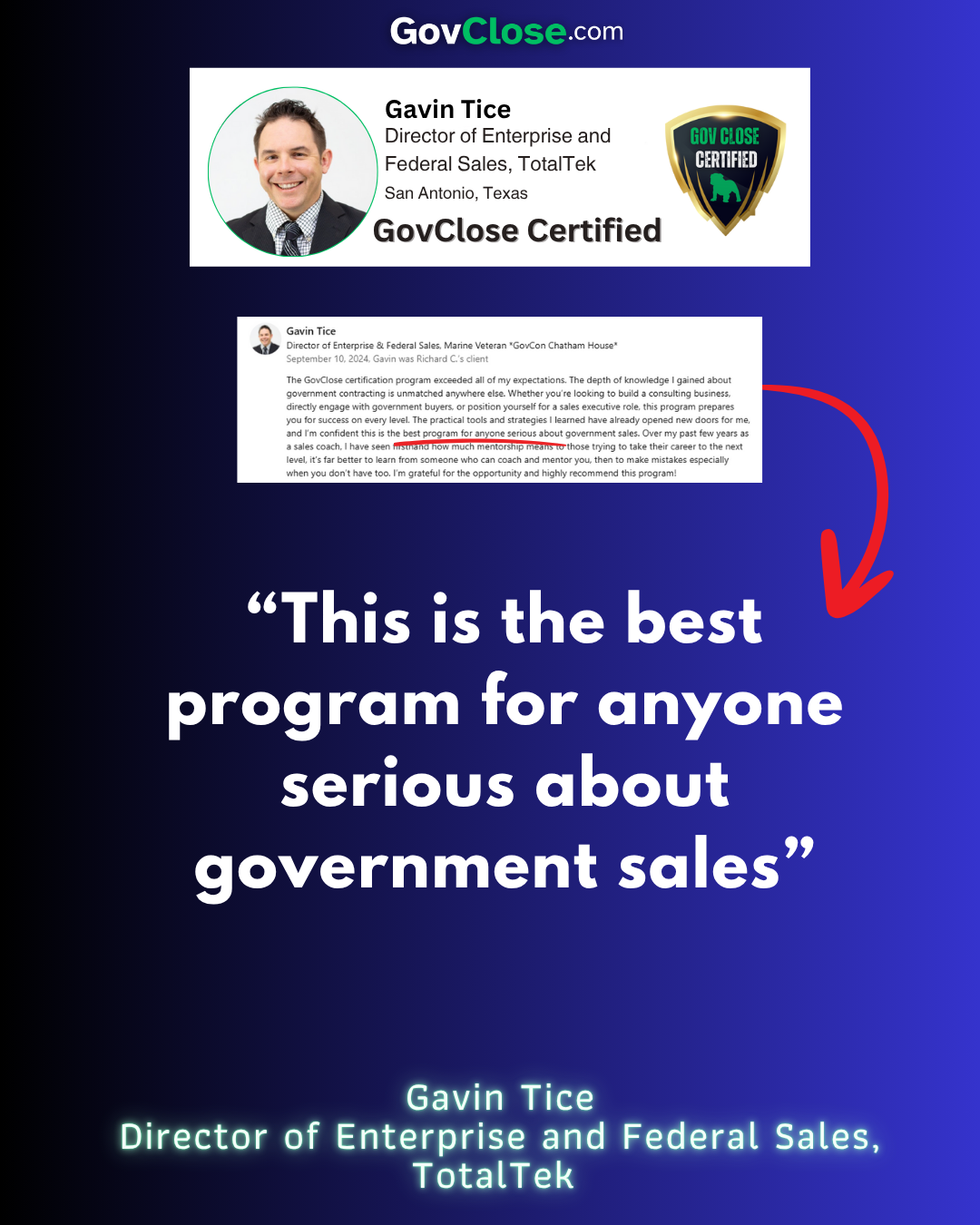
Toward the end of the video, I introduce the GovClose certification program because it directly addresses everything I’ve talked about.
It’s a year-long training and implementation program designed to build:
-
Deep understanding of government contracting
-
Practical sales and pipeline discipline
-
Repeatable lead generation habits
-
Real-world execution skills
This isn’t just education. It’s coaching, accountability, and collaboration.
Participants get access to a shared “war room” environment where real opportunities, real challenges, and real decisions are worked through together — in real time.
Government contracting is hard to figure out alone. Structure matters.
Final Thought
If there’s one thing I want people to take away from this, it’s this:
Success in government contracting is built on habits, not heroics.
Consistent lead generation.
Daily pipeline discipline.
Ongoing education.
Do those three things well — even when you’re busy, even when you’re winning — and you dramatically increase your odds of long-term success in this space.
That’s the mindset I bring to every client, every program, and every conversation — and it’s the mindset I want you to build into your business.
If you have ideas for future videos or topics you want me to break down, let me know. I’m always listening.
👉 Learn more about starting your consulting business at GovClose.com
👉 Hire a GovClose-Trained Consultant here: https://match.govclose.com
👉 Get Weekly Government Contracting Business Tips: https://federalytics.substack.com
👉 Explore the GovClose Certification Program for step-by-step training
👉 Follow me on LinkedIn for free live training and Q&A
Turn Government Contracting Knowledge Into Income
This isn’t a course. It’s a certification and implementation system to help you build a consulting business, land a high-paying sales role, or scale your own company in federal contracting.
We hate SPAM. We will never sell your information, for any reason.