Government Contract Careers for Veterans in 2026
Apr 01, 2026When you transition out of the military, one of the hardest parts isn’t just finding a job.
It’s finding something that actually feels meaningful.
You go from a structured environment, a clear mission, and a strong sense of community… to a world where most opportunities feel disconnected from everything you’ve built your life around.
And that’s where a lot of veterans get stuck.
They’re capable. They’re disciplined. They’re proven under pressure.
But they’re trying to fit into career paths that don’t fully value what they bring to the table.
I want to show you a different path—one that not only makes sense for veterans, but actually gives you a real advantage.
That path is government contracting.
Why Government Contracting Makes Sense for Veterans
Here’s the part most people overlook:
You don’t need prior government contracting experience to succeed in this space.
What you do need is something veterans already have.
You understand how the military works.
You understand the mission.
You understand the structure, the language, the decision-making process.
That alone puts you ahead of most civilians trying to break into this world.
Companies pay a premium for people who can bridge that gap—who can “speak the language” and navigate the system.
And that’s exactly what you’ve been doing your entire career.
The Three Paths Veterans Can Take
When it comes to government contracting, there isn’t just one way in. There are three primary paths I see veterans take—and each one has real income potential.
Let’s break them down.
Path #1: Become an Account Executive (Sales Role)
This is one of the fastest ways to get into the space and start earning at a high level.
In this role, you’re working for a company that sells products or services to the federal government. Your job is to help them win contracts.
Now, if you’ve never done sales before, don’t let that throw you off.
This isn’t about cold calling or pushing products.
It’s about strategy.
It’s about understanding:
- What the government actually needs
- What your competitors are doing
- How to position your company the right way
Veterans tend to do very well here because they already understand the customer.
They know how to communicate.
They know how to build trust.
They know how to operate in structured environments.
And the compensation reflects that.
It’s not uncommon to see:
- Base salaries starting around $120,000
- Commissions that push total earnings well into six figures
- Top performers making $300,000+
Why? Because federal contracts are large, complex, and high-value—and companies are willing to pay for people who can help them win.
Path #2: Start a Freelance Consulting Business
This is where things start to open up even more.
Instead of working for one company, you’re working with multiple clients—helping them navigate government contracting.
You’re essentially becoming the person companies rely on to:
- Identify opportunities
- Develop strategy
- Improve positioning
- Guide them through the process
And the best part?
You don’t need a huge team to start.
Many veterans begin by setting up a simple LLC and offering services like:
- Business development
- Proposal support
- Market research
- Compliance (like CMMC)
From there, it scales.
You might start with one client. Then two. Then five.
And because this is typically recurring work, it adds up quickly.
It’s very realistic to see:
- $5,000 to $10,000 per month per client
- Multiple clients at once
- A flexible, remote work lifestyle
But what most people don’t realize is that consulting opens doors beyond just income.
It puts you in the room with decision-makers.
CEOs. Founders. Executives.
And from there, opportunities expand into:
- Joint ventures
- Equity deals
- Fractional executive roles
- Subcontracting partnerships
You’re no longer just working—you’re building leverage.
Path #3: Grow Your Existing Business with Government Contracts
If you already own a business, this path can be a game-changer.
Adding government contracting as a revenue stream can take a small business and scale it in a big way.
But I want to be clear about something:
This path requires patience.
Government contracts don’t happen overnight.
You’re looking at a 6 to 18-month timeline in many cases, especially in the beginning.
That means:
- Building relationships
- Understanding agency needs
- Positioning your company
- Navigating the acquisition process
It’s a longer runway compared to consulting.
But the upside?
It’s significant.
One contract can completely change the trajectory of your business.
The Advantage Veterans Have (That Most Don’t)
Here’s where veterans really stand out.
You already understand:
- How government organizations operate
- The chain of command
- The importance of mission alignment
- The internal language and culture
That’s not something you can easily teach.
Companies can train someone on a product.
They can’t easily teach someone how to navigate military systems and communicate effectively within them.
That’s why veterans are so valuable in this space.
Certifications That Can Give You an Edge
If you’re going the business route, there are also certifications that can significantly improve your positioning.
One of the most important is:
Service-Disabled Veteran-Owned Small Business (SDVOSB)
This certification can:
- Open doors to set-aside contracts
- Give you priority with certain agencies
- Increase your visibility in the market
For example, agencies like the VA actively look to work with veteran-owned businesses.
That’s a built-in advantage you should absolutely take advantage of.
The Reality: This Isn’t Instant—but It Is Worth It
I want to set the right expectation.
This isn’t a “get rich quick” path.
Whether you go into sales, consulting, or growing a business, there’s a learning curve.
There’s a process.
There’s time involved.
But once you understand how this system works, everything changes.
You stop guessing.
You stop chasing random opportunities.
You start operating with clarity and strategy.
Why Community and Training Matter
One of the biggest mistakes I see veterans make is trying to figure this out alone.
Government contracting is complex.
There are rules, processes, and nuances that take time to learn.
That’s why having the right environment matters.
When you’re surrounded by people who are:
- Learning the same system
- Applying the same strategies
- Sharing insights and experiences
You accelerate your progress.
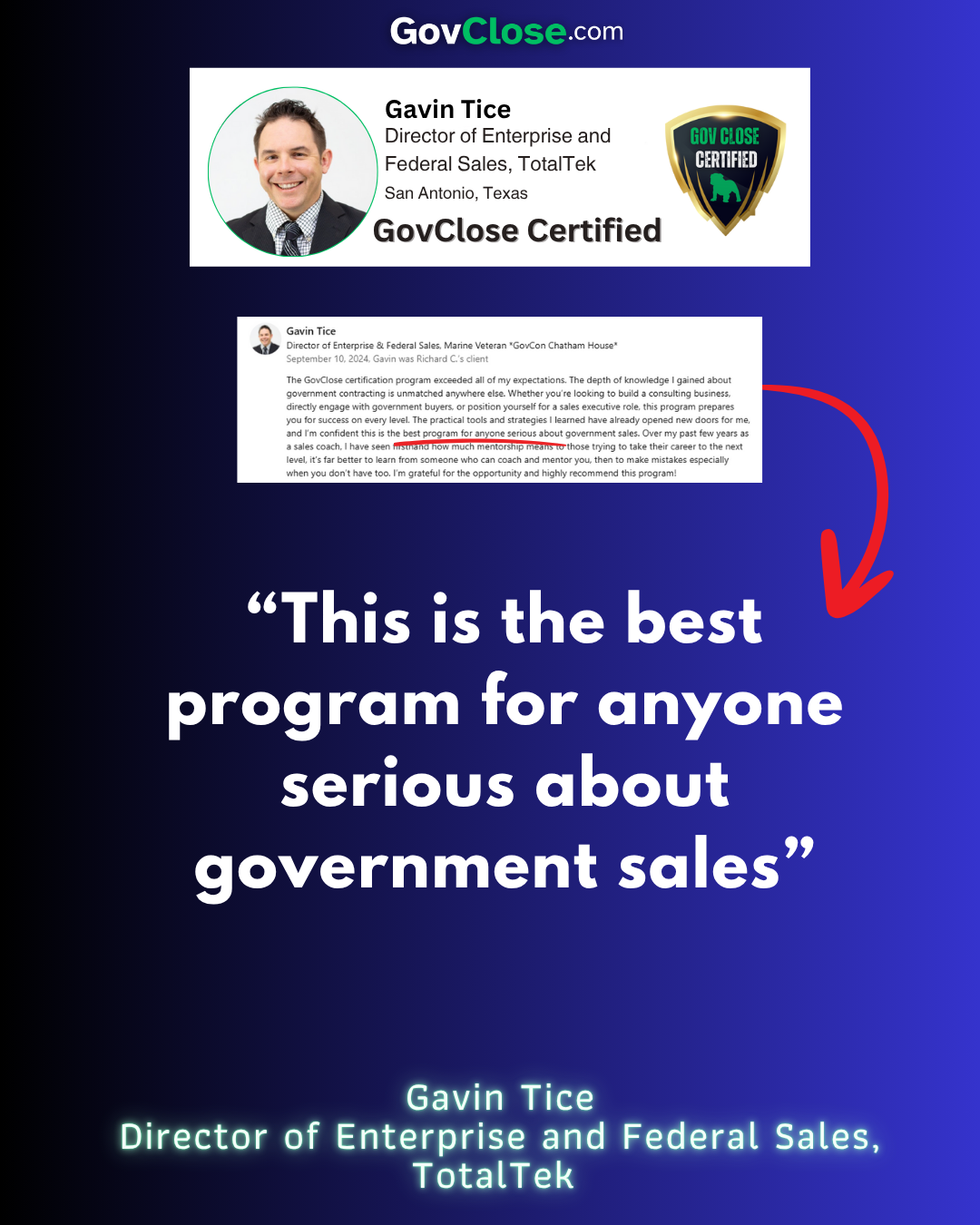
That’s exactly why we built the GovClose program—to give veterans a structured path, real guidance, and a community that understands where they’re coming from and where they’re trying to go.
Because this isn’t just about learning.
It’s about executing.
Final Thought: A New Mission
Transitioning out of the military doesn’t mean losing your sense of purpose.
It just means redirecting it.
Government contracting gives you a way to:
- Build real income
- Stay connected to the mission
- Work within a system you already understand
- Create long-term opportunity for yourself and your family
And most importantly—it gives you a path where your experience actually matters.
If you approach it the right way, this isn’t just another career option.
It’s a strategic advantage.
👉 Learn more about starting your consulting business at GovClose.com
👉 Hire a GovClose-Trained Consultant here: https://match.govclose.com
👉 Get Weekly Government Contracting Business Tips: https://federalytics.substack.com
👉 Explore the GovClose Certification Program for step-by-step training
👉 Follow me on LinkedIn for free live training and Q&A
Turn Government Contracting Knowledge Into Income
This isn’t a course. It’s a certification and implementation system to help you build a consulting business, land a high-paying sales role, or scale your own company in federal contracting.
We hate SPAM. We will never sell your information, for any reason.